biologists

Adrian is Presenting his Thesis Today!

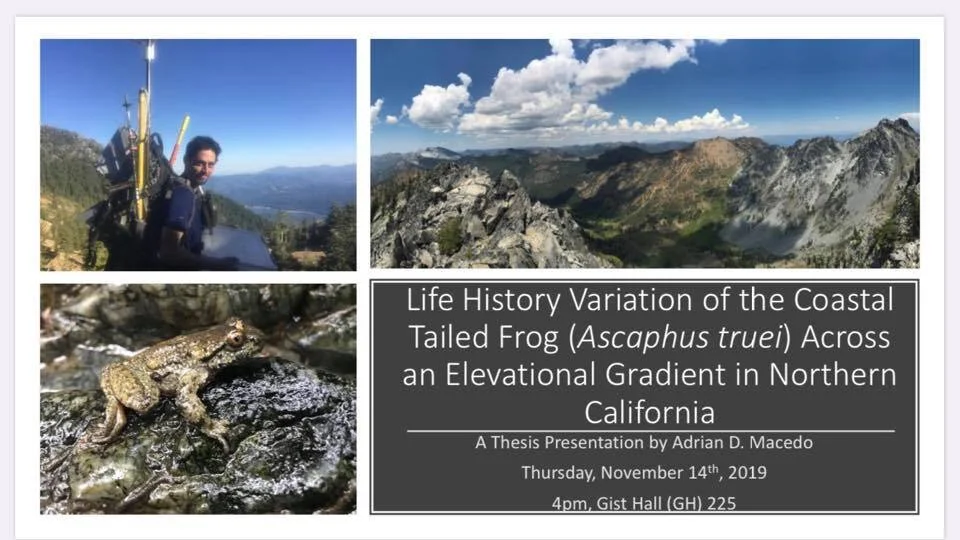
Our own Adrian Macedo will be presenting his thesis today on the history of Tailed Frogs Across Elevation Gains in Northern California today at 4pm in Gist Hall. Adrian has done important work in the conservation for many species in addition to the his work with Tailed Frogs. He has had a lifetime of experience in biology as his father is the branch chief of the California Department of Fish and Wildlife Habitat Conservation Planning Branch. Adrian has received multiple scholarships and awards and has an exhaustive resume of accomplishments. We are very grateful for his work with us this summer, helping us identify species of special concern including raptors and amphibians. Congratulations Adrian!
Most tadpoles have mouths at the front of the head, but the mouth of a Coastal Tailed Frog tadpole is underneath the head, which is flattened. The mouth position and head shape, along with specialized folds that create suction, help a tadpole cling …

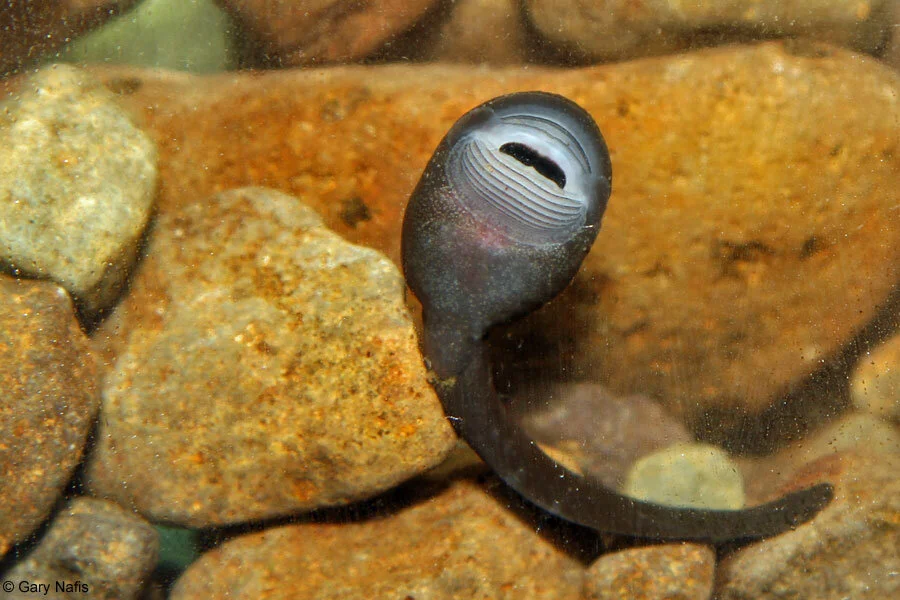
Most tadpoles have mouths at the front of the head, but the mouth of a Coastal Tailed Frog tadpole is underneath the head, which is flattened. The mouth position and head shape, along with specialized folds that create suction, help a tadpole cling to a rock surface while keeping its body close to the rock. This allows a tailed frog tadpole to scrape food off the surface of underwater rocks in fast-moving creeks without letting the swift current wash it downstream. (California Herps 2019)
Adult male Coastal Tailed Frog showing his tail-like copulatory organ. This organ, an extension of the cloaca, is used to transfer sperm into the female's cloaca during amplexus. She then holds the fertilized eggs for 9 or 10 months when she swims u…

Adult male Coastal Tailed Frog showing his tail-like copulatory organ. This organ, an extension of the cloaca, is used to transfer sperm into the female's cloaca during amplexus. She then holds the fertilized eggs for 9 or 10 months when she swims under a large stone on the bottom of a fast-moving creek and attaches the eggs to the bottom of the stone. This internal fertilization strategy lets tailed frogs breed in fast-moving water without the eggs washing away, which would happen if they were laid and fertilized on the surface of the water. (California Herps 2019)
Caution with Drones and Wildlife Please

Recently there was a presentation at the Sunrise Rotary Club in Arcata regarding the use of drones near pelagic bird colonies and the disruption and stress it is causing to many nesting species. The drones often fly to close, stress the birds and often they fly off of nests, leaving them open to predation. The Audobon society has written on various ways drones are affecting bird species.

On the most recent Wildlife Society newsletter, an article in National Geographic titled “Viral bear video shows dark side of filming animals with drones” . It clearly shows a mother bear and cub climbing a difficult and treacherous snowy mountain. The cub falls a bit and is almost back up when the drone startles the bears, and the tiny cub falls again, almost to his death.

The cub does make it back up to his anxious mother, the these interactions of drones and wildlife are happening more often, frequently through simple ignorance and carelessness.

Drones have been useful for environmental science and biology, as have other tools like wildlife cameras and tracking devices. The tools can also be disturbing and detrimental. Please be aware of any observation that you conduct and help spread awareness of the use of drones and impacts to wildlife.

Thank you!

Totally Batty Workshop!

Through the Western Section of the The Wildlife Society we were able to attend a workshop for the Ecology and Field Methods for the study of bats. During our habitat assessments for projects, we encounter numerous local bat species which are listed Species of Special Concern (SSC) by the California Department of Fish and Wildlife.

The California Environmental Quality Act (CEQA; California Public Resources Code §§ 21000-21177) requires State agencies, local governments, and special districts to evaluate and disclose impacts from "projects" in the State. Section 15380 of the CEQA Guidelines clearly indicates that species of special concern should be included in an analysis of project impacts if they can be shown to meet the criteria of sensitivity outlined therein.

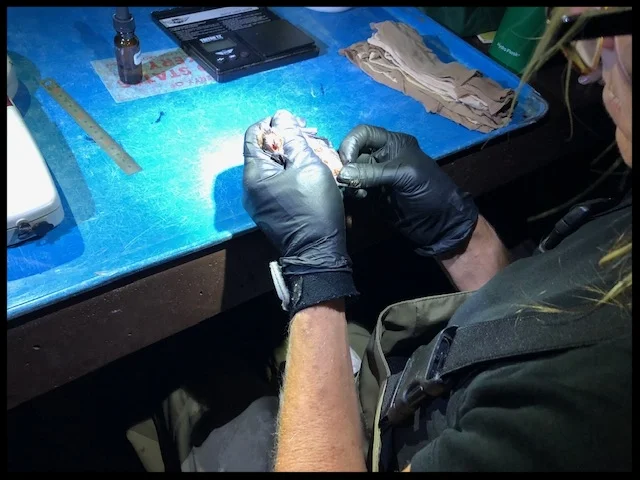
This workshop combined lecture, discussion, and field exercises regarding ecology and conservation of California bats, covering species accounts, physiology, anatomy, behavioral ecology, conservation issues, and mitigation strategies. We employed field techniques of mist-netting, assessing species presence or absence, and acoustic monitoring to gain hands-on experience in monitoring and analysis. During evening field excursions we typically captured a half dozen bat species and, for those with proof of current rabies vaccination, we were allowed practice in extracting, handling, as well as collecting and recording data from captured bats. The following is a list of bats in Humboldt County that are commonly observed.

Scientific Name Common Name

  • Antrozous pallidus pallid bat

  • Corynorhinus townsendii Townsend's big-eared bat

  • Lasionycteris noctivagans silver-haired bat

  • Lasiurus blossevillii western red bat

  • Lasiurus cinereus hoary bat

  • Myotis evotis long-eared myotis

  • Myotis thysanodes fringed myotis

  • Myotis volans long-legged myotis

  • Myotis yumanensis Yuma myotis

Find your own ways to learn more about these creatures, which are extrememly important for pest-control and ecology. Here are some links to get you started!

Bats of the Humboldt Redwoods

The Wildlife Society

Information Regarding Species of Special Concern

Why Bats are Important

Build Your Own Bat House

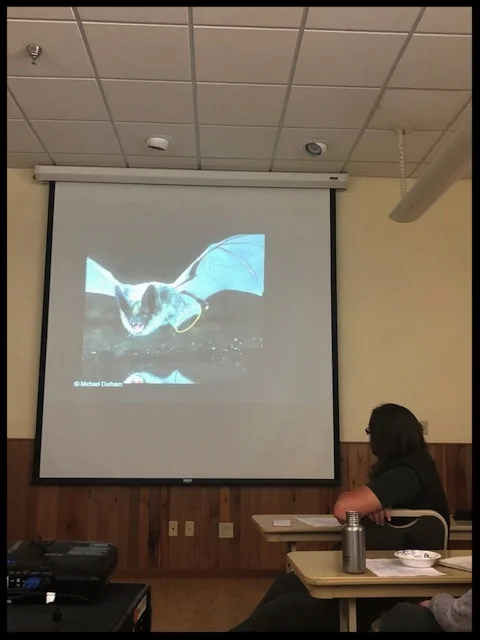
Classroom portion-Taxonomy, identification and ecology

Classroom portion-Taxonomy, identification and ecology

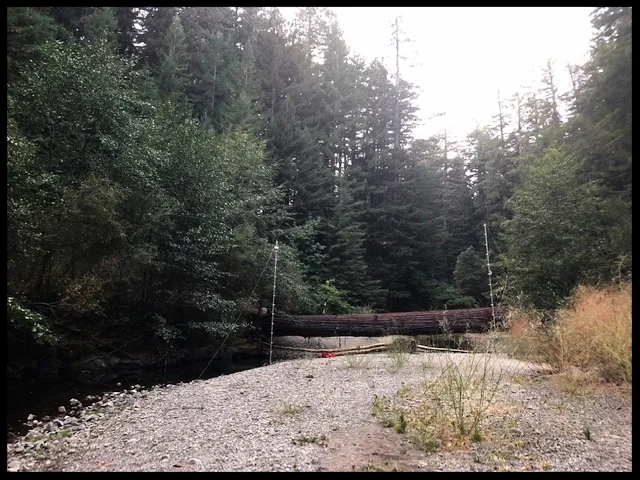
Mist nets going up

Mist nets going up

Male Myotis

Male Myotis