

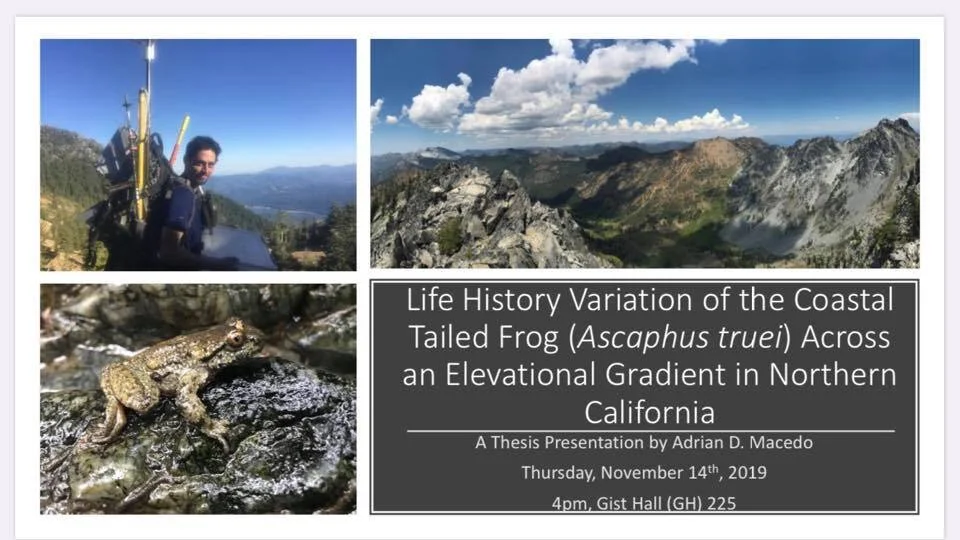
Our own Adrian Macedo will be presenting his thesis today on the history of Tailed Frogs Across Elevation Gains in Northern California today at 4pm in Gist Hall. Adrian has done important work in the conservation for many species in addition to the his work with Tailed Frogs. He has had a lifetime of experience in biology as his father is the branch chief of the California Department of Fish and Wildlife Habitat Conservation Planning Branch. Adrian has received multiple scholarships and awards and has an exhaustive resume of accomplishments. We are very grateful for his work with us this summer, helping us identify species of special concern including raptors and amphibians. Congratulations Adrian!
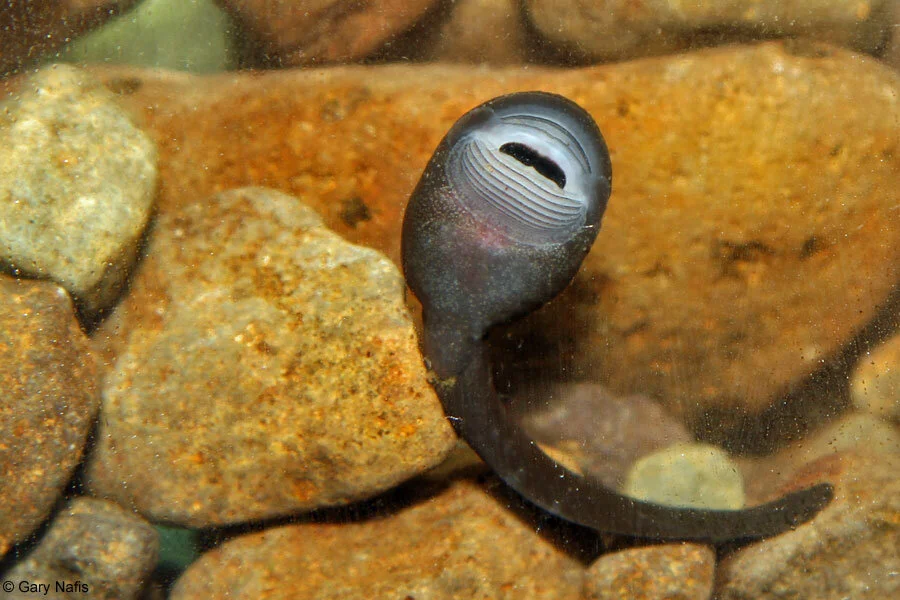
Most tadpoles have mouths at the front of the head, but the mouth of a Coastal Tailed Frog tadpole is underneath the head, which is flattened. The mouth position and head shape, along with specialized folds that create suction, help a tadpole cling to a rock surface while keeping its body close to the rock. This allows a tailed frog tadpole to scrape food off the surface of underwater rocks in fast-moving creeks without letting the swift current wash it downstream. (California Herps 2019)
Adult male Coastal Tailed Frog showing his tail-like copulatory organ. This organ, an extension of the cloaca, is used to transfer sperm into the female's cloaca during amplexus. She then holds the fertilized eggs for 9 or 10 months when she swims under a large stone on the bottom of a fast-moving creek and attaches the eggs to the bottom of the stone. This internal fertilization strategy lets tailed frogs breed in fast-moving water without the eggs washing away, which would happen if they were laid and fertilized on the surface of the water. (California Herps 2019)